Vitamin D - It’s Not Just For Your Bones!
Vitamin D is fondly known for its role in bone health and supporting strong bones and/or to reduce the risk of developing osteoporosis. The primary reason why people are taking vitamin D, especially as they get older. What isn’t quite as known is that vitamin D has important roles in the body beyond helping to maintain bone mineral density. It also plays a major role in immune health as well.
The Benefits of Vitamin D:
Bone Density: Vitamin D is just one of many factors along with physical activity, other nutritional habits, genetics and lifestyle to help maintain bone mass. The way vitamin D works is by helping absorb calcium from the intestines to maintain blood calcium levels, which in turn keeps calcium in the bones (1). Often supplements combine vitamin D and vitamin K2. K2 helps direct the calcium to the bones.
Muscle strength: There is some research that shows Vitamin D is able to increase muscle synthesis and growth via increasing type 2 muscle fibres in the muscle which can also help to reduce falls (1).
A Positive for Mood: A case report demonstrated that correcting vitamin D deficiency reduced depression scores in women (2). This can be related to reducing the inflammation that is associated with depression. Less inflammation enables the brain to produce more serotonin. Other anti-inflammatory agents can be used along with getting to the root cause of inflammation - gut dysbiosis, food sensitivities, chronic infection, or something else. This may be a vitamin to consider if you experience seasonal depression or seasonal affective disorder.
Immune Health: It helps to regulate the immune system and reduces the amount of pro-inflammatory cytokines while increasing anti-inflammatory cytokines. This helps to reduce inflammation and can be a good option for autoimmune conditions (3) and also help to recover sooner from colds and flus.
Skin Health: It can be beneficial in many skin conditions like eczema, psoriasis, and acne through regulating keratinocyte differentiation and/or its role in supporting the immune system (4).
How do you Obtain Vitamin D?

FOOD
Unfortunately, the availability of the vitamin through food sources is limited with salmon and other fatty fish, eggs, and milk being the main sources. This means vegetarians and vegans and whoever avoids fish, dairy, and/or eggs have to rely on a vitamin D supplement.
SUN
Vitamin D can be made through skin exposure to UVB radiation (sun’s rays). UVB radiation reacts with cholesterol on the skin surface to begin the vitamin D formation cascade (1). If we live near the equator where the UVB rays are strongest, there is a better chance of having adequate vitamin D levels, especially for fair-skinned individuals. Living in the northern hemisphere, our UVB rays are weaker, especially in the winter months which means our skin cannot make as much vitamin D.
It’s important to mention those individuals who are darker skinned and have more melanin will have reduced Vitamin D formation in the skin as the melanin soaks up the UVB rays rendering less UVB available for converting the cholesterol to initiate the formation of vitamin D.
SUPPLEMENTS
The lack of dietary and UVB exposure make supplements a good choice for obtaining therapeutic levels. Doses can range from 1000IU or more for adults based on your health status and therapeutic need, which is why it is best to consult a healthcare professional to determine how much you should be taking. Just like many other supplements, there can be a certain thing such as taking too much vitamin D.
The Science of How Vitamin D Is Made?
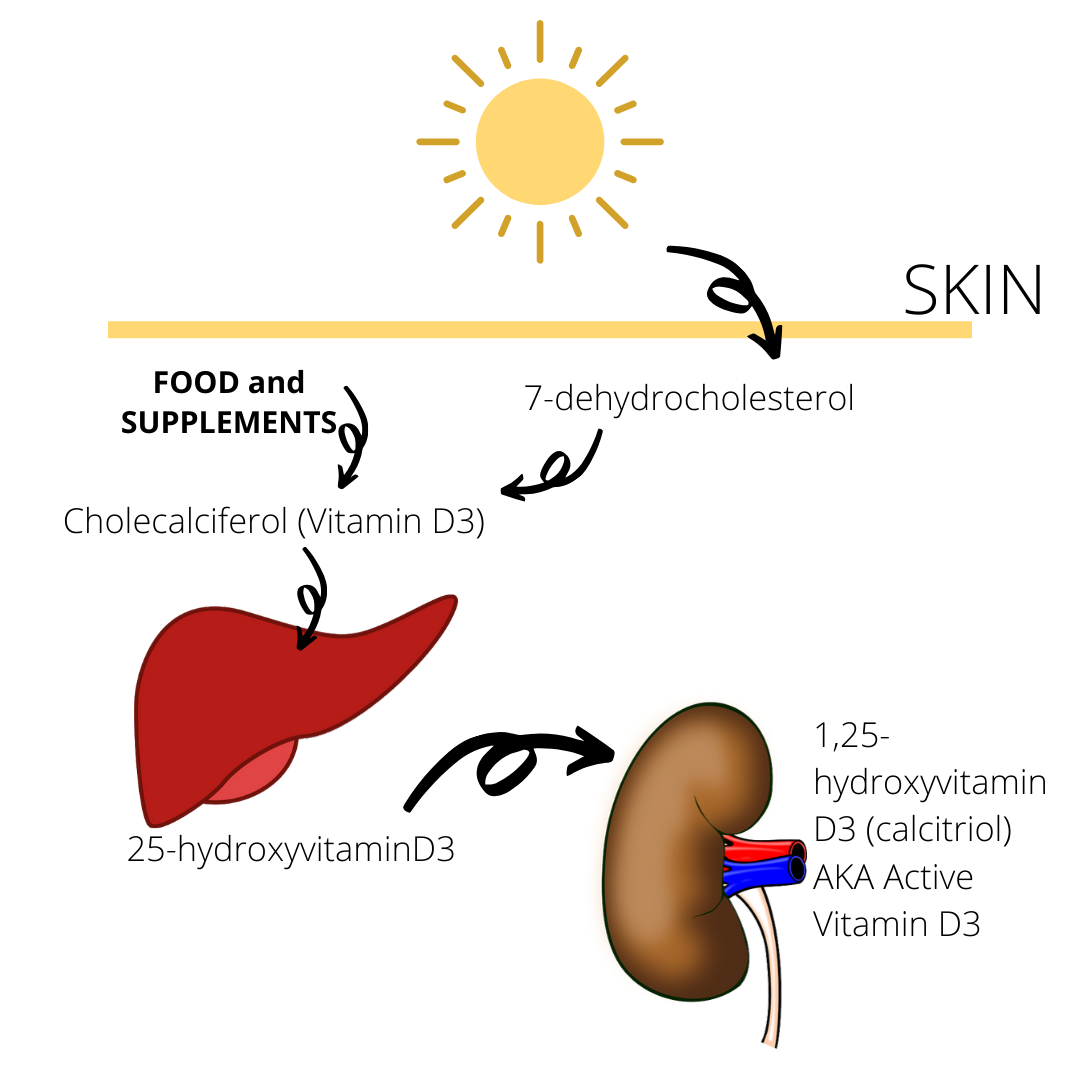
Calcitriol (1,25-hydroxyvitaminD3) is the active form of Vitamin D which is made in the kidneys. Calcitriol is responsible for increasing intestinal calcium absorption, binding to vitamin D receptors in the body and performing vitamin D functions. In order to obtain calcitriol, one must have a well-functioning liver and kidneys. The Liver makes 25-hydroxyvitamin D, the more abundant form in blood and more commonly tested. This then travels to the kidneys to form calcitriol. This is why many individuals with kidney disease will often be given prescription calcitriol since their kidneys unable to make sufficient vitamin D.
Is Testing Necessary Or Should I Just Supplement?
Ideally, it is good to test your vitamin D prior to supplementing to obtain a baseline value and then re-test in 3-6 months to know if the supplement is working and your levels are increasing. If your levels do not increase, this may point to an absorption issue.
If you already have been taking Vitamin D for years, it is always a good idea to test to make sure your levels are going up and within optimal range.
Further, vitamin D is a fat-soluble vitamin which means that it gets stored in fat tissue. Increased Vitamin D levels can lead to increased calcium absorption and high blood calcium levels. High calcium, in severe cases, can cause nausea, vomiting, frequent urination, weakness, bone pain, and calcium-based kidney stones. While Vitamin D toxicity is rare, it is something to be aware about, especially if you have been taking vitamin D for a long period of time. (5)
Family physicians are reluctant to test Vitamin D and are actually unable to order it unless they have a very good medically documented reason for doing so. There are 3-4 reasons that an MD will be able to requisition a vitamin D through provincial healthcare. If you don’t meet one of those criteria, you will have to pay for it if you can even convince your family physician to check it off on the requisition. Fortunately, naturopathic doctors can fill this gap by ordering Vitamin D testing – yes there will be a small fee, but it is better to know your levels, especially if you have an immune-related illness or gut issues and also to make sure supplementation is working for you!
**For new patients seeing our ND, you will need to undergo an initial assessment (which can be covered by extended health insurance naturopathic coverage). This also helps to see if there are other tests we should do in conjunction with testing vitamin D.
References:
Laird E, Ward M, McSorley E, Strain JJ, Wallace J. Vitamin D and bone health; potential mechanisms. 2010 Jul;2(7):693-724.
Endocrine Society. (2012, June 25). Treating vitamin D deficiency may improve depression. ScienceDaily. Retrieved November 23, 2019 from www.sciencedaily.com/releases/2012/06/120625152358.htm
Aranow C, MD. Vitamin D and the immune system. J Investig Med. 2011 Aug;59(6):881-886.
Mostafa WZ, Hegazy RA. Vitamin D and the skin: focus on a complex relationship: a review. J Adv Res. 2015 Nov;6(6):793-804.
Marcinowska-Suchowierska E, Kupisz-Urbanska M, Lukaszkiewicz J, Pludowski P, Jones G. Vitamin D toxicity – a clinical perspective. Front Endocrinol (Lausanne). 2018;9:550.